WE HAVE SOME GREAT LIMITED-TIME OFFERS - CLICK HERE TO VIEW THEM WE SHIP WORLDWIDE    /    All UK ORDERS GREATER THAN £75 EX VAT DELIVERED FREE    /    WE SHIP WORLDWIDE    /    ALL EUROPEAN ORDERS GREATER THAN £500.00 ex VAT DELIVERED FREE    /    WE SHIP WORLDWIDE
    Share this page on Facebook   Share this page on LinkedIn   Share this page on Twitter   Share this page on Whatsapp   

    Rapid Ref : ThoriatedTungsten  

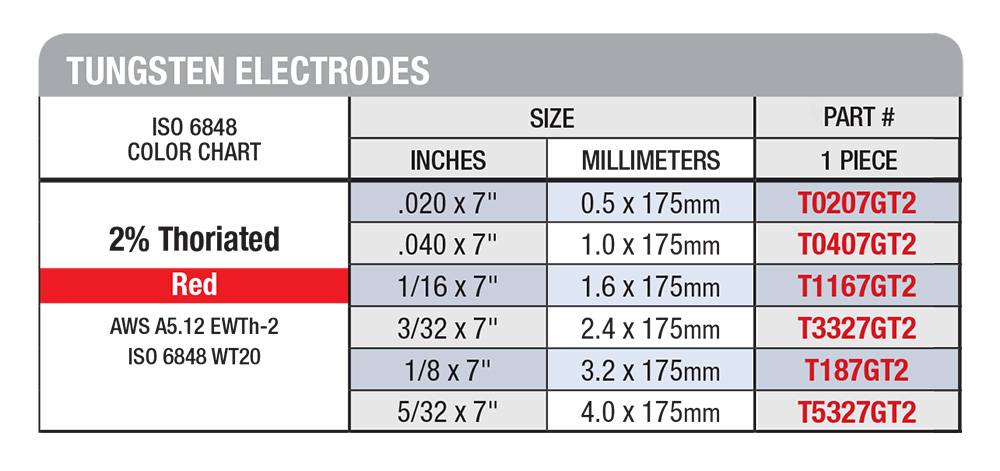
    CK 2% Thoriated (Red) Tungsten Electrode, 175mm (7") Long
    ThoriatedTungsten

    Select Option 
    Prices From £0.52 ex VAT


    2% THORIATED (RED) EWTh-2/WT20

    Principal Oxide: 1.7-2.2% Thorium Oxide

    RADIOACTIVE. Best for use in Direct Current (D/C) applications using transformer-based content current power sources. Best for use on non-corroding steels, titanium alloys, nickel alloys, and copper alloys. Good D/C arc starts and stability, medium erosion rate, medium amperage range, medium tendency to spit.
    CK-TUNGSTEN-ELECTRODE-RED-DESCRIPTION-IMAGE

    Brochures & Manuals

    Tungsten Electrodes FAQs

    Straight answers to the questions people ask most when choosing and using tungsten electrodes for TIG welding.

    Which type of tungsten electrode should I choose?icon-minus-redicon-plus-red

    It depends on the metal, whether you weld on DC or AC, and your machine. For DC welding on steel, stainless steel, nickel alloys and copper, lanthanated, ceriated and thoriated types are common. For AC welding on aluminium, zirconiated and pure tungsten were the traditional choice, and many modern machines work well with lanthanated or mixed-oxide types.

    Each type has a small amount of an oxide added, which affects arc starting, stability and life. If you are unsure, a general-purpose lanthanated or ceriated type is a sensible starting point for many jobs.

    What do the colours on tungsten electrodes mean?icon-minus-redicon-plus-red

    The coloured band on the end of an electrode shows the type. Common examples are red for thoriated, grey for ceriated, white for zirconiated and green for pure tungsten. Lanthanated electrodes use several colours depending on the amount of oxide, and some other blends have colours that vary between makers.

    Colour codes are widely used, but always check the packaging, since a maker's colour may differ from what you expect. The band is often on the end that gets cut or ground off, so mark or keep track of the type once it has gone.

    What diameter of tungsten do I need?icon-minus-redicon-plus-red

    The right diameter depends on the welding current, and the maker publishes a current range for each size. A tungsten that is too thin for the current overheats, melts at the tip and can shed particles into the weld. One that is too thick for low current gives an unstable, hard-to-start arc.

    Choose a diameter that covers your usual current, and check it fits your torch, since the collet and collet body must match the tungsten diameter. A thicker tungsten generally copes with more current.

    What length of tungsten should I use?icon-minus-redicon-plus-red

    Standard electrodes come in set lengths and most general-purpose torches take the common length. Shorter lengths are used in some small and compact torches, and can also be handy where space is tight.

    Check the length your torch and back cap can hold. As the electrode wears down with regrinding, you will eventually be left with a short stub, which should be replaced when it becomes too short to grip properly.

    Shop Similar Categories