WE HAVE SOME GREAT LIMITED-TIME OFFERS - CLICK HERE TO VIEW THEM WE SHIP WORLDWIDE    /    All UK ORDERS GREATER THAN £75 EX VAT DELIVERED FREE    /    WE SHIP WORLDWIDE    /    ALL EUROPEAN ORDERS GREATER THAN £500.00 ex VAT DELIVERED FREE    /    WE SHIP WORLDWIDE
    Share this page on Facebook   Share this page on LinkedIn   Share this page on Twitter   Share this page on Whatsapp   

    Rapid Ref : 308050  

    HMT VersaDrive ImpactaTap - UNC Thread Size
    308050

    Select Option 
    Prices From £29.79 ex VAT

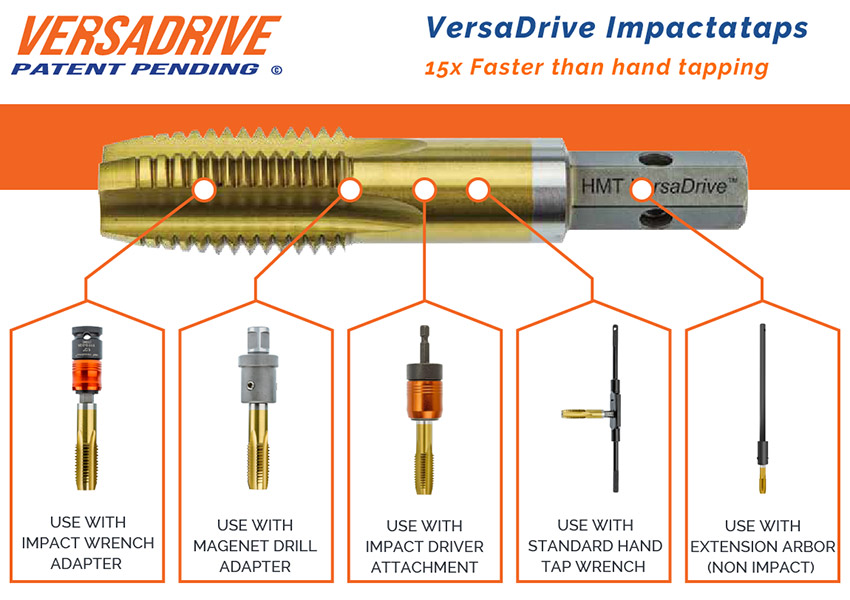
    HMT VersaDrive ImpactaTaps

    FIFTEEN TIMES FASTER THAN HAND TAPPING.

    VersaDrive ImpactaTaps perform best when adapted with an Impact wrench for Tapping through holes. However, they can also be adapted for use in a reversible Magnet Drill or even used with any standard Hand Tap wrench.

    Fast Tapping with Minimal Kickback; Specially hardened for Impact Wrench use. Chipbreaker action for Automatic chip clearance when Impact Tapping. Unique Dual-Point Starting Angle for easy alignment and fast cut. High-Grade Tool Steel with Ground Flutes for high accuracy & long life. GoldMax low-friction Titanium coating to stop heat burnout. High Strength, Non-slip Shank Design.

    Product Details

    HMT Taps FAQs

    Answers to common questions about choosing and using taps and thread chasers for cutting and restoring internal threads.

    What is the difference between a tap and a thread chaser?icon-minus-redicon-plus-red

    A cutting tap makes a new thread by removing metal from a plain drilled hole. A thread chaser is designed to clean up and re-form a thread that already exists, following the existing thread path without cutting away much material.

    For threads that are dirty, burred or lightly damaged, a chaser is usually the gentler first choice. A cutting tap can remove too much thread material and weaken the thread, so it suits new holes. If a thread is badly stripped, replacing the part or fitting a threaded insert is normally the better repair.

    Should I use a spiral flute tap or a spiral point tap?icon-minus-redicon-plus-red

    The choice depends on where the chips can go. A spiral point tap pushes chips ahead of it, so it suits through holes where chips can leave the far side. A spiral flute tap draws chips back out along its flutes, so it suits blind holes.

    Using a spiral point tap in a blind hole can pack chips at the bottom until the torque rises sharply and the tap breaks. Spiral flute taps are generally not recommended for very hard materials, so check the maker's guidance for the material you are tapping.

    How do I choose the right drill size before tapping?icon-minus-redicon-plus-red

    A tapped hole starts with a drilled hole, called the tap drill, which is smaller than the thread's nominal size so that metal remains to form the thread. For metric coarse threads a common workshop rule is the nominal diameter minus the pitch, and a finer pitch therefore needs a larger drill than a coarse pitch of the same diameter.

    The rule is only a quick estimate, so use a tap drill chart for your thread and the maker's guidance, especially for fine, inch, pipe or special threads. A hole that is too small overloads the tap, while one that is too large leaves a shallow thread with less holding strength. Drill square and remove any burr at the entry.

    What are taper, plug and bottoming taps?icon-minus-redicon-plus-red

    These describe how long the lead-in chamfer is on a hand tap. A taper tap has the longest chamfer, which spreads the cutting load and makes it the easiest to start straight. A plug tap has a shorter chamfer and is the general-purpose choice for through holes and blind holes with room at the bottom.

    A bottoming tap has only a very short chamfer, so it can cut a thread close to the bottom of a blind hole, but it does not start as freely and is usually used to finish a hole already started with a taper or plug tap. Chamfer lengths vary between makers, so check the tap's specification.

    Shop Similar Categories