WE HAVE SOME GREAT LIMITED-TIME OFFERS - CLICK HERE TO VIEW THEM WE SHIP WORLDWIDE    /    All UK ORDERS GREATER THAN £75 EX VAT DELIVERED FREE    /    WE SHIP WORLDWIDE    /    ALL EUROPEAN ORDERS GREATER THAN £500.00 ex VAT DELIVERED FREE    /    WE SHIP WORLDWIDE
  • CK-D4GSXXXLD  CK 3 Series Large Diameter Gas Saver Kit, with Pyrex Cup
  • CK-D4GSXXXLD  CK 3 Series Large Diameter Gas Saver Kit, with Pyrex Cup
Share this page on Facebook   Share this page on LinkedIn   Share this page on Twitter   Share this page on Whatsapp   

Rapid Ref : CK-D4GSXXXLD  

CK 3 Series Large Diameter Gas Saver Kit, with Pyrex Cup
CK-D4GSXXXLD

Select Option 
Prices From £92.10 ex VAT

The CK Large Diameter Gas Saver front end is used to provide an inert atmosphere for the welding of reactive metals such as titanium, molybdenum, nickel-based and aluminium-based alloys, as well as non-reactive metals like stainless steel.

This design is lightweight, allowing for operator comfort and accurate control. The front end also uses a clear Pyrex cup creating excellent visibility of the weld puddle. The clear cup features an inside diameter of 1 1/8" (28.57mm) which is the largest cup orifice available on the market today.

This design offers a replaceable, interchangeable tungsten adaptor; and a universal collet body, creating less inventory, and allowing inexpensive screen replacement. Tungsten stick-out can be up to 2" (50.8mm) in certain conditions.

This kit allows welders to weld low amperage Titanium without a trailing shield. Great for tack welding outside of an inert chamber and repairs of small cracks. 3 Series Fits 17 18 & 26 Torch Models.
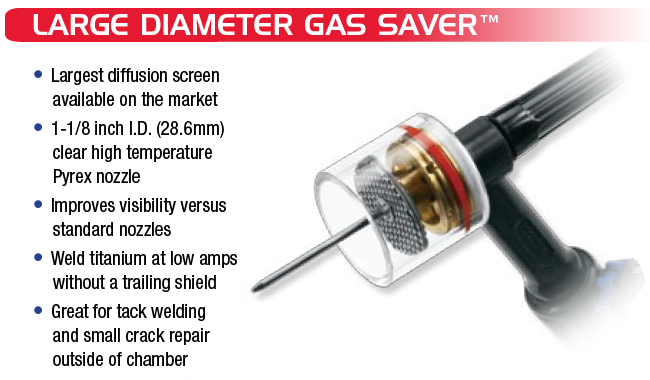
 CK Large Diameter Gas Saver Kit

Product Details

CK 3 Series Gas Saver Kits FAQs

Gas lens front-end kits for medium-size TIG torches: what they do, how to choose the cup and how to get the best from them.

What is a gas lens kit and what does it do on a TIG torch?icon-minus-redicon-plus-red

A gas lens kit replaces the standard collet body and cup at the front of the torch. Inside the gas lens body sits a stack of fine mesh screens that smooths the argon into a steadier, more even stream as it leaves the cup. A standard collet body releases gas through a few small holes, which tends to make the flow more turbulent.

The smoother flow gives better shielding of the weld pool and the hot tungsten, and it lets you extend the electrode further out of the cup than a standard collet body allows. Kits normally come as a set of matching parts so everything fits together.

Will a gas lens really let me use less gas?icon-minus-redicon-plus-red

It can. Because the flow is smoother, many welders find they can run a lower flow rate than with a standard collet body and still get a clean weld. Savings quoted by makers are best treated as a best case, since the result depends on the joint, any draughts and how far you cut the flow.

The sensible approach is to use the lowest flow that still gives good protection for your application. Reduce the flow gradually, and if you see dark flecks, discolouration or porosity, raise it a little. Too much flow is also harmful because it adds turbulence and can pull air into the shield.

Should I choose an alumina cup or a glass cup?icon-minus-redicon-plus-red

Alumina (ceramic) cups are opaque and are the tough, general-purpose choice. They cope better with knocks and heat than glass.

Clear glass cups let you see the tungsten, arc and puddle through the cup, which helps in inside corners, around tube and on precision work. Glass is more fragile and may not stand up to the same heat or rough handling, so check the cup maker's maximum current and any other limits before using one. With larger cups and longer stick-out the visibility advantage matters less, so many welders return to alumina.

What size of cup should I choose?icon-minus-redicon-plus-red

Cup sizes are numbered in sixteenths of an inch of inside diameter, so a larger number means a wider cup. A larger cup gives a longer, calmer flow and better coverage, and suits a gas lens, longer tungsten reach and metals that need extra protection.

A smaller cup gets into tighter spaces and uses less gas, but it raises gas speed, which can cause turbulence. Joint design usually decides: pipe roots and tight corners favour a smaller or shorter cup, open joints and critical stainless work favour a larger one. As a guide, the cup should be wide enough relative to the tungsten diameter, and the torch must be able to take the size you choose.

Shop Similar Categories