WE HAVE SOME GREAT LIMITED-TIME OFFERS - CLICK HERE TO VIEW THEM WE SHIP WORLDWIDE    /    All UK ORDERS GREATER THAN £75 EX VAT DELIVERED FREE    /    WE SHIP WORLDWIDE    /    ALL EUROPEAN ORDERS GREATER THAN £500.00 ex VAT DELIVERED FREE    /    WE SHIP WORLDWIDE
    Share this page on Facebook   Share this page on LinkedIn   Share this page on Twitter   Share this page on Whatsapp   

    Rapid Ref : 1G44-R  

    Gullco Katbak 1G44-R Ceramic Weld Backing Tiles, 9m Box
    1G44-R

    £35.94  EX VAT
    SSP Suggested Selling Price = £40.10  YOU SAVE £4.16
     Buy in 3 easy interest free payments of £11.98† with

    This tile is larger and has a larger groove than the 1G42 tile or the 1G41-R tile where the user needs more penetration and more substance in the tile. Possibly for submerged arc welding applications and thicker plates. Each tile is radiused to form a strip around the cylinder.

    Can be used as shown below.

    • Impart X-ray quality back beads on root pass
    • Weld one side only
    • Deposit more weld metal
    • Root weld and fill in one pass
    • Eliminate defects and rework
    • Eliminate costly unnecessary gouging and grinding
    • Sizes 1/4” (6.3 mm) to 6” (152.4 mm)
    • Special sizes and configurations available
    • Conveniently packaged and sealed in plastic for moisture-proof protection
    • Wider heat receptive pressure sensitive foil for improved adhesion to work piece

    9m - 30ft./ box
    Available in 1/4” to 2” (6.3mm to 50.8mm) tiles.
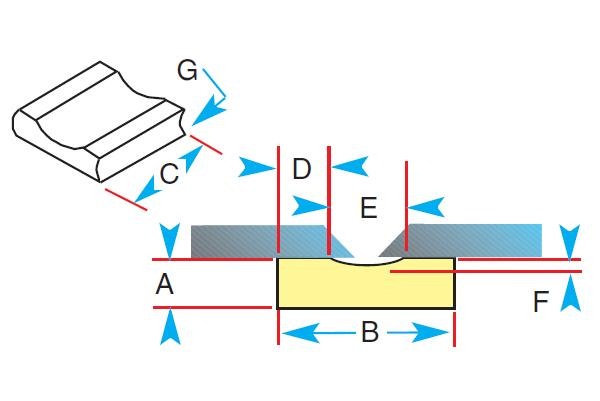
    Gullco Katbak 1G44-R

    Specifications
    A 3/8 in
    9.5 mm
    B 1 1/4 in
    31.7 mm
    C 1 in
    25.4 mm
    D 9/32 in
    7.2 mm
    E 11/16 in
    17.5 mm
    F 1/64 in
    1.6 mm
    G 1/4 in
    6.3 mm

    Brochures & Manuals

    BROCHURES & MANUALS
       View Brochure

    Ceramic Backing Tiles FAQs

    Straight answers to the questions people ask most when choosing and using ceramic weld backing tiles.

    What are ceramic backing tiles and what are they used for?icon-minus-redicon-plus-red

    Ceramic backing tiles are strips of heat-resistant ceramic, usually fixed along the back of a joint with an adhesive aluminium foil tape. They support the molten weld metal from behind, so you can make a full-penetration weld from one side only.

    They are widely used in shipbuilding, structural steelwork, tanks and pressure parts where the back of the joint cannot be reached, or where welding and then gouging from the second side would take too long. They are used with MIG, flux-cored, stick and submerged arc welding, depending on the type of tile.

    How do I choose the right tile shape and size?icon-minus-redicon-plus-red

    The tile shape controls the profile of the root bead, and it must suit the joint. Flat tiles, grooved tiles with a round or square channel, and tiles with different groove widths are made for different joint preparations, root gaps and plate thicknesses. Some are designed for corner or fillet joints, and others for curved surfaces.

    The tile maker's guidance links each tile to the root gap and bevel it was designed for, so match the tile to your joint preparation and welding procedure. If you are unsure, ask the maker or our team.

    Why is my root bead poor or not fusing at the edges?icon-minus-redicon-plus-red

    The usual causes are a root gap that is too narrow or wide for the tile, a tile that does not sit squarely under the joint, poor contact between the tile and the metal, or settings and technique that don't suit the joint. Lack of fusion at the edges can come from too low a current or travel that is too fast.

    Welding over damp tiles can cause porosity. Check the fit-up, the tile position and the foil seal, and prove the settings on a test piece before welding the real joint.

    How do I remove the tile after welding?icon-minus-redicon-plus-red

    Let the joint cool and then remove the foil tape and ceramic. The ceramic is brittle, so it usually breaks away with a light tap from a hammer or chipping tool. Wear eye protection, because ceramic fragments can fly.

    Clean away any remaining ceramic or residue, and inspect the root side of the weld. Follow the tile instructions on whether a tile can be used again. A light clean may be all the root needs, but the specification for the job decides what finishing is required.

    Shop Similar Categories