WE HAVE SOME GREAT LIMITED-TIME OFFERS - CLICK HERE TO VIEW THEM WE SHIP WORLDWIDE    /    All UK ORDERS GREATER THAN £75 EX VAT DELIVERED FREE    /    WE SHIP WORLDWIDE    /    ALL EUROPEAN ORDERS GREATER THAN £500.00 ex VAT DELIVERED FREE    /    WE SHIP WORLDWIDE

Tungsten Electrodes

CK-TUNGSTEN-ELECTRODES-BANNER

Tungsten Electrodes FAQs

Straight answers to the questions people ask most when choosing and using tungsten electrodes for TIG welding.

Which type of tungsten electrode should I choose?icon-minus-redicon-plus-red

It depends on the metal, whether you weld on DC or AC, and your machine. For DC welding on steel, stainless steel, nickel alloys and copper, lanthanated, ceriated and thoriated types are common. For AC welding on aluminium, zirconiated and pure tungsten were the traditional choice, and many modern machines work well with lanthanated or mixed-oxide types.

Each type has a small amount of an oxide added, which affects arc starting, stability and life. If you are unsure, a general-purpose lanthanated or ceriated type is a sensible starting point for many jobs.

What do the colours on tungsten electrodes mean?icon-minus-redicon-plus-red

The coloured band on the end of an electrode shows the type. Common examples are red for thoriated, grey for ceriated, white for zirconiated and green for pure tungsten. Lanthanated electrodes use several colours depending on the amount of oxide, and some other blends have colours that vary between makers.

Colour codes are widely used, but always check the packaging, since a maker's colour may differ from what you expect. The band is often on the end that gets cut or ground off, so mark or keep track of the type once it has gone.

Why do people avoid thoriated tungsten?icon-minus-redicon-plus-red

Thoriated tungsten contains a mildly radioactive oxide. The electrode itself is normally low risk to handle, and the main concern is the dust from grinding, which can be breathed in or swallowed. For that reason many workshops now prefer non-radioactive types that perform similarly on DC.

If you do use thoriated tungsten, follow the HSE guidance, the maker's instructions and your own risk assessment, particularly on grinding, dust control, storage and disposal.

What is the difference between pure and alloyed tungsten?icon-minus-redicon-plus-red

Pure tungsten has no oxide added and is the simplest type. Alloyed tungstens have small amounts of an oxide, such as thoria, ceria, lanthana or zirconia, which makes them easier to start, improves arc stability and lets them carry more current for their size.

Pure tungsten is mostly used for AC welding on aluminium, though modern machines and alloyed electrodes have largely taken over. For most work an alloyed tungsten gives a longer life and easier starts.

What diameter of tungsten do I need?icon-minus-redicon-plus-red

The right diameter depends on the welding current, and the maker publishes a current range for each size. A tungsten that is too thin for the current overheats, melts at the tip and can shed particles into the weld. One that is too thick for low current gives an unstable, hard-to-start arc.

Choose a diameter that covers your usual current, and check it fits your torch, since the collet and collet body must match the tungsten diameter. A thicker tungsten generally copes with more current.

What length of tungsten should I use?icon-minus-redicon-plus-red

Standard electrodes come in set lengths and most general-purpose torches take the common length. Shorter lengths are used in some small and compact torches, and can also be handy where space is tight.

Check the length your torch and back cap can hold. As the electrode wears down with regrinding, you will eventually be left with a short stub, which should be replaced when it becomes too short to grip properly.


1.5% LANTHANATED (GOLD) EWLa-1.5/WU5

Principal Oxide: 1.3-1.7% Lanthanum Oxide

NON-RADIOACTIVE. Best for use in Direct Current (D/C) as an alternative to 2% Thoriated using inverter or transformer based constant current power sources. Best for non-corroding steel, titanium alloys, nickel alloys, copper alloys, Best D/C arc starts and stability, low erosion rate, wide amperage range, no spitting.


2% LANTHANATED (BLUE) EWLa-2/WL20

Principal Oxide: 1.8-2.2% Lanthanum Oxide

NON-RADIOACTIVE. Best general-purpose electrode for both Alternating Current (A/C) or Direct Current (D/C) using inverter or transformer based constant current power sources. Good for low-alloyed steels, non-corroding steels, aluminium alloys, magnesium alloys, titanium alloys, nickel alloys, copper alloys. Good arc starts and stability, medium to high amperage range, low erosion rate.


2% THORIATED (RED) EWTh-2/WT20

Principal Oxide: 1.7-2.2% Thorium Oxide

RADIOACTIVE. Best for use in Direct Current (D/C) applications using transformer-based content current power sources. Best for use on non-corroding steels, titanium alloys, nickel alloys, copper alloys. Good D/C arc starts and stability, medium erosion rate, medium amperage range, medium tendency to spit.


0.8% ZIRCONIATED (WHITE) EWZr-8/WZ8

Principal Oxide: 0.7-0.9% Zirconium Oxide

NON-RADIOACTIVE. Best for use in alternative current (A/C) for aluminium alloys and magnesium alloys using inverter or transformer based constant current power sources. Balls, well, handles higher amperage than pure tungsten with less spitting, better arc starts and arc stability than pure tungsten.


2% CERIATED (GREY) (FORMERLY ORANGE) EWCe-2/WC20

Principal Oxide: 1.8-2.2% Cerium Oxide

NON-RADIOACTIVE. Best for use in Alternative Current (A/C) or Direct Current (D/C) applications using inverter or transformer based constant current power sources. Good for low-alloyed steels, non-corroding steels, aluminium alloys, magnesium alloys, titanium alloys, nickel alloys, copper alloys. Good ignition and re-ignition properties, long service life, excellent arc stability. Low erosion rate, best at low amperage range, no spitting, good D/C arc starts and stability.
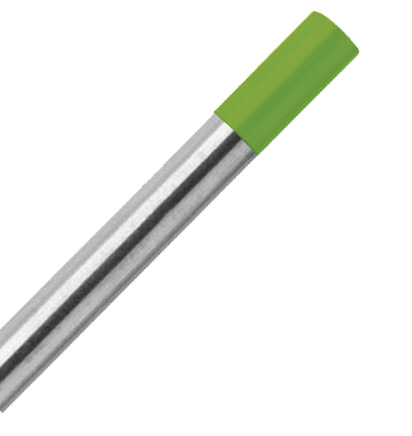

LaYZr (CHARTREUSE) EWG

Principal Oxides: 1.5% Lanthanum, 0.08% Zirconium, 0.08% Yttrium Oxides

NON-RADIOACTIVE. Best for automated or robotic applications in Alternating Current (A/C) or Direct Current (D/C) due to low voltage tolerance (changes in tip to work piece distance) using inverter or transformer based constant current power sources. Good for low-alloyed steels, non-corroding steels, aluminium alloys, magnesium alloys, titanium alloys, nickel alloys, copper alloys, Very stable tip geometry, runs cooler than 2% Thoriated with longer life, low to medium amperage range. Very best low amperage starts.