WE HAVE SOME GREAT LIMITED-TIME OFFERS - CLICK HERE TO VIEW THEM WE SHIP WORLDWIDE    /    All UK ORDERS GREATER THAN £75 EX VAT DELIVERED FREE    /    WE SHIP WORLDWIDE    /    ALL EUROPEAN ORDERS GREATER THAN £500.00 ex VAT DELIVERED FREE    /    WE SHIP WORLDWIDE
    Share this page on Facebook   Share this page on LinkedIn   Share this page on Twitter   Share this page on Whatsapp   

    Rapid Ref : 309020-SET1  

    HMT VersaDrive Spiral Flute ImpactaTap InsertFoam 5 Piece Set (1/4, 5/16, 3/8, 1/2, 5/8" UNC)
    309020-SET1

    Click here to see what's included

    £308.85  EX VAT
    SSP Suggested Selling Price = £363.35  YOU SAVE £54.50
     Buy in 3 easy interest free payments of £102.95† with

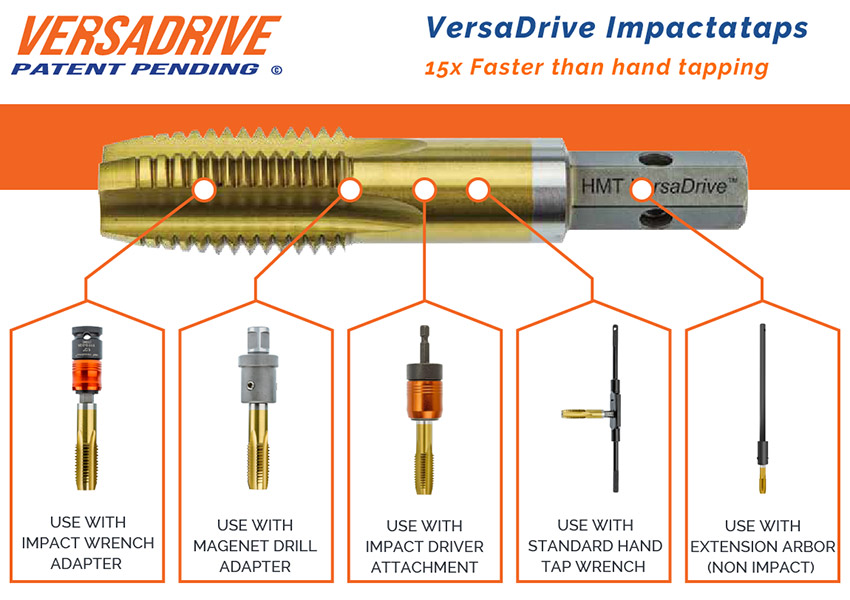
    HMT VersaDrive ImpactaTaps

    15X FASTER THAN HAND TAPPING.

    VersaDrive Spiral Flute Taps are designed for tapping deep & blind holes. Can also be adapted for use in a reversible Magnet Drill, or even used with any standard Hand Tap wrench.

    Specially Hardened, High-Grade Tool Steel with Ground Flutes for high accuracy & long life. GoldMax low-friction Titanium coating to stop heat burnout. High Strength, Non-slip Shank Design.

    Product Details

    Brochures & Manuals

    BROCHURES & MANUALS
       View Brochure

    HMT Taps FAQs

    Answers to common questions about choosing and using taps and thread chasers for cutting and restoring internal threads.

    Should I use a spiral flute tap or a spiral point tap?icon-minus-redicon-plus-red

    The choice depends on where the chips can go. A spiral point tap pushes chips ahead of it, so it suits through holes where chips can leave the far side. A spiral flute tap draws chips back out along its flutes, so it suits blind holes.

    Using a spiral point tap in a blind hole can pack chips at the bottom until the torque rises sharply and the tap breaks. Spiral flute taps are generally not recommended for very hard materials, so check the maker's guidance for the material you are tapping.

    Why do taps break, and how can I avoid it?icon-minus-redicon-plus-red

    A tap is hard and brittle, and it rarely breaks without warning. Common causes are a hole drilled too small, chips packing in the flutes, the wrong tap style for a blind or through hole, hitting the bottom of a blind hole, side loading from a tap that is not square, and too little lubricant.

    Check the tap drill size, keep the tap square, use suitable cutting fluid and clear the chips by backing off regularly. Stop if the tap suddenly becomes harder to turn, as forcing it is how most taps snap.

    Why do some taps come oversize for galvanised work?icon-minus-redicon-plus-red

    When a part is galvanised, the zinc coating adds thickness to the threads, which can increase the diameter of a bolt thread. The nut or tapped hole therefore needs to be cut slightly larger so that the coated bolt can be assembled. This is called overtapping, and it is why oversize taps exist.

    An oversize tap is not a general replacement for a standard tap, because a nut tapped oversize will fit loosely on an uncoated bolt. Check the maker's marking and the requirement for your fastener before choosing.

    What are taper, plug and bottoming taps?icon-minus-redicon-plus-red

    These describe how long the lead-in chamfer is on a hand tap. A taper tap has the longest chamfer, which spreads the cutting load and makes it the easiest to start straight. A plug tap has a shorter chamfer and is the general-purpose choice for through holes and blind holes with room at the bottom.

    A bottoming tap has only a very short chamfer, so it can cut a thread close to the bottom of a blind hole, but it does not start as freely and is usually used to finish a hole already started with a taper or plug tap. Chamfer lengths vary between makers, so check the tap's specification.

    Shop Similar Categories